Superman Begins to Find the American Way
The Great DC Sightsee


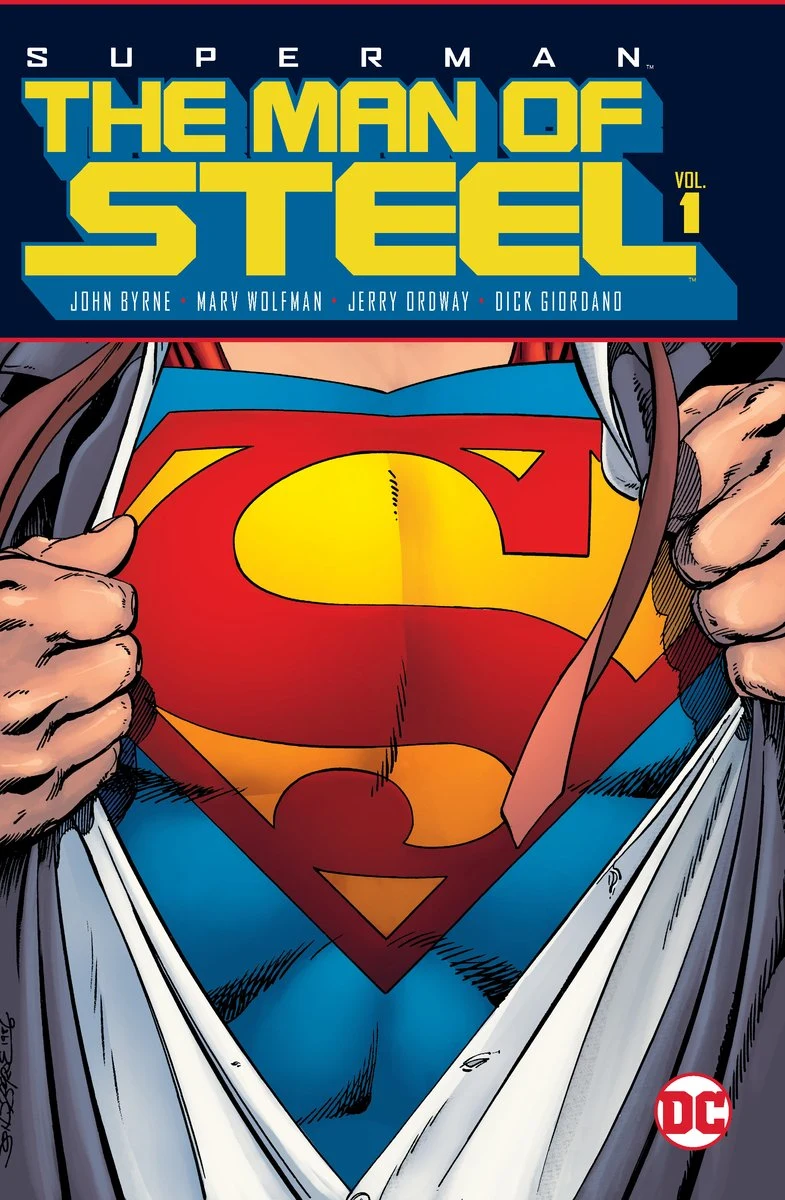
After relaunching the Man of Steel via the similarly titled miniseries in 1986, John Byrne and his fellow Superman collaborators had three ongoing comic series to adapt to the new status quo. Superman, Adventures of Superman, and Action Comics were all interconnected and starred the same Clark Kent, alongside his more marketable alter ego. The task before these lines was large: create the foundations for an iconic, indefinite character which both respected past publication history and did not, at the very least directly, contradict each other. The result is a slow-moving characterization of Superman, one where common themes are explored through distinct, disconnected stories and settings spread across a relatively large selection of issues. In this collection, readers see their hero grapple with his identity and moral compass at home, internationally, and across the stars.
After the Man of Steel miniseries, the ‘86 reboot of Superman was built on a familiar framework: his Kryptonian origins, childhood in Smallville, eventual move to Metropolis, and career as a reporter. Through all the moving starting pieces, the actual personality of Clark Kent fell by the wayside. The audience is aware that their protagonist is a good man, hardworking and kind, but when they read him proclaim that he will use his powers responsibly, they still have to ask what Superman’s perspective is on such a concept. This book shoves the hero into his new world and begins to test his ethics with a barrage of villains sporting motivations of wide varieties.
The first three issues of the collection are written by John Byrne, author of the preceding miniseries, and they serve a pretty interesting function in building expectations for the updated character. From the get-go, the comic shows readers this is no longer the era of a wacky, limitless Superman, with the hero beaten and his weakness exposed in the inaugural issue.
Metallo, the kryptonite-powered-robot-man, beats Superman to a pulp in their first meeting, and the comic takes a relatively bold move in not immediately walking back the defeat. Instead of the down-and-out hero gritting his teeth and winning the day despite all odds, as might be expected, the savior of the day is Lex Luthor. With a push of a button, Luthor ends Metallo’s short reign and makes it clear that nobody is going to take his prey away from him.

Luthor will lord over the remainder of the comic in a position of near absolute power, which does establish an interesting dynamic for the rest of the book’s events. We see the evil genius immediately target Clark Kent, as our hero’s alter ego was never clever enough to hide a connection to Superman. The result is two of the most telling scenes in the bunch, both concerning the effects of power.
First, when Luthor meddles with Smallville, readers get a glimpse of a snapped Superman; one who is no longer holding himself back. In a fit of justified rage, there is a moment where it seems the protagonist will make a bold decision and refuse to play the game in which he and Luthor are constantly engaged. Superman is stopped by Luthor’s wielding of the Kryptonite harvested from Metallo, though, so we see the positions flipped before the hero can act. Luthor's singular ability to debilitate Superman is an important sticking point for the continuing comics, but the story offers a more iconic and revealing moment for the supervillain.
After constructing a supercomputer and feeding it all the data on Superman that he has compiled, Luthor is sure he will be given an answer to the hero’s secret identity. When he is given the correct answer, Clark Kent is Superman, Luthor cannot accept the result and makes an uncharacteristic dismissal of the scientific analysis. With Luthor’s denial of reality, the book creates an environment where the leading man can be invulnerable and nigh-unstoppable without losing all sense of tension and stakes. As Superman moves forward, he has to stay aware that Luthor could take him out, while also unknowingly benefiting from the fact that his alter ego is all but safe from discovery.
Finally, with the new era of The Man of Steel solidified and the major pillars of worldbuilding in place, the comic is ready to launch in earnest and delve into some deeper themes. Readers are presented with the fictional country dubiously dubbed Qurac, and described as a haven for terrorists in the Middle East. In the introductory scene to the nation, an American corporation is seen meddling in the affairs of Qurac, and after an attempt at bullying in the name of oil by the US, the relationship between the entities is severed on bad terms.

In response to the slight, Qurac sends a futuristic centipede tank to attack Metropolis. As they proclaim themselves fighters against America's imperialistic actions, Superman swoops in to stop their spree of destruction and death. The Man of Steel subdues the attack, though not before establishing that the centipede runs off the energy from its inhabitants and, in fact, many of them perish by operating the mechanism. It is a sort of weird and shallow swipe at the idea of terrorists who take their own lives, and the comic uses it to show just how horrified Superman is at the concept of such warfare.
Of course, these issues raise a glaring question: how far will Superman go to stop the bad guys? Our protagonist has a clear conscience about wielding his powers to save the people of Metropolis, yet he has refrained from inserting himself into the imperialism and intervention from his home country that precipitated the retaliation in the first place. In the text, we know the hero cannot raise a finger against Luthor and his enterprises specifically, but the theme extends to the entire class of American corporations.
Both Superman and the Quracis cannot directly strike the all-powerful wealthy businessmen, so they are forced to fight each other on the streets of Metropolis. The practical result is that Superman becomes an attack dog for massive corporations. If the hero is forced to protect the interests of Luthor and elite individuals, their city, property, family, safety, etc., then they fail to receive any repercussions for their overreaching actions. Both the readers and the protagonist are left wondering whether Superman should take a different approach to his whole heroic endeavor.
Eventually, the hero will go down the only lane he is brave enough to take, and bring the fight to Qurac. First, however, Superman is swept away into the Legends DC comic crossover, where he is coerced into dealing with systemic injustice in a more direct way than he has ever dared to engage in on Earth.

The Legends material featuring Superman is fun and has a straightforward plot that avoids being boring. Really, though, the main purpose of these comics is to first introduce the New Gods to Superman readers in the post-Crisis context and, second, expose the title hero directly to the woes of the oppressed.
Seeing the destitution of the planet Apokolips firsthand, Superman first leads a direct revolution against the standing system, and then, thanks to a little brainwashing, turns and squashes the rebels beneath his heel. Readers get a tease of New Gods melodrama, and then Superman is sent back to Earth, where his experience as a freedom fighter pushes him into further action.
Upon his return, Superman decides he needs to take the fight to Qurac, a move he admits he previously would not have considered appropriate, but his mindset has begun to change in the wake of recent conquests. His reluctance to act outside the US illustrates the hero’s identity as an American and shows that his personal ethical system has, until now, implicitly incorporated the laws and standards of his country. Superman shows himself to be authentically American by taking the fight overseas before ever reflecting on the root of the issues at home.
In Qurac, the only obstacle that proves difficult for Superman is a cat man and his skull-faced wife, who try to use mind magic to take down the Man of Steel. The hero overcomes the mental attacks and demolishes the entirety of Quracian military might. While Superman leaves the Middle East in apparent victory, he also leaves behind a vacuum of power that can not remain empty for long.

The structure of Superman’s journey is reminiscent of the disillusioned prince archetype. Seen in tales such as that of The Buddha and Moses, a person of privilege descends from isolation and comfort to experience the real world and all its tricks and treachery. A reflection of the latter’s instinctual reactions to seeing senseless harm, Superman strikes out against the perceived injustice, perhaps without considering the greater picture. Unfortunately, the book is not always nuanced and often feels as though it backs the hero's unilateral decisions without question.
This presentation of the Man of Steel has a lot of promise. He is unworldly, weak-principled, and holds a plethora of unchecked biases. He is the quintessential American. Superman shies away from confronting the corporate power brokers who extract comfort and wealth from across the globe and replace it with toil and hardship, primarily because of their position in the US. As a hero, he allows himself to be cowed by the laws of home, without ever investigating the intentions and real-world results of such policies.
Take, for example, the character of Bloodsport, a side storyline within this collection. The villain is billed as a PTSD-ravaged Vietnam veteran, only to be later revealed as the world’s least sympathetic anti-war protester. The comic has to tie itself in knots to both give Bloodsport some semblance of a believable beginning rooted in the blowback of American warfare, while simultaneously refusing actually to condemn the violent acts. In fact, the book makes sure to honor the distributors of horror and shames those who would stand against them. Superman, and the comic itself, does not view Bloodsport as a similar symptom to the Qurac attacks, where both result from US international interventions; instead, it simply sees two more nails that need to be hammered with American exceptionalism.
These issues are taking much larger swings than I expected. The specific focus on international politics and the trials of the downtrodden invites bold questions about the nature of good versus evil and the appropriate circumstances to wield power are legitimately interesting dichotomies. Unfortunately, the book does not engage with the topics it approaches; it actually tries to hide behind the shield of its protagonist’s goodness, which readers are expected to accept inherently. The story’s attempt to flatten the complex issues underpinning its conflicts creates a shallow theme of single-minded patriotism that does not do the iconic character justice.

Taking a step back from the meat of the title, there is a lot to admire in these pages. The art is clean and vibrant, though it does not stand on the same level as contemporary work from the likes of Pérez and Miller. The easy-to-digest style and simple, appealing aesthetic put forward here will remain the norm for DC Comics and its top competitor for years to come.
A lot of compelling drama happens between the bigger moments, including blossoming relationships and stark moral conundrums. My favorite growing dynamic is the convoluted love triangle, with almost four sides, between Lois Lane/Superman and Cat Grant/Clark Kent. The stories of Perry White’s son’s kidnapping and Professor Hamilton's flawed shield both offer nuanced counterpoints to Superman's actions and reveal more subtlety than the book tends to allow. Going forward, the continuing adventures of the Man of Steel have room to elevate themselves into a truly fascinating narrative and inspection of the American way of life. However, the book also leaves open a track of obvious pandering and unexamined beliefs, which I have no confidence will be avoided.
Citation Station
The Man of Steel Volume 1. 1986. John Byrne, Marv Wolfman, Jerry Ordway, Terry Austin, Dick Giordano, Mike Machlan, Karl Kesel, John Costanza, Tom Ziuko, Andrew Helfer, Albert De Guzman, Anthony Tollin, Mike Carlin, Robert Greenberger. DC Comics.