The Grueling Fun of Precious Rubbish
Indie Thing Under the Sun


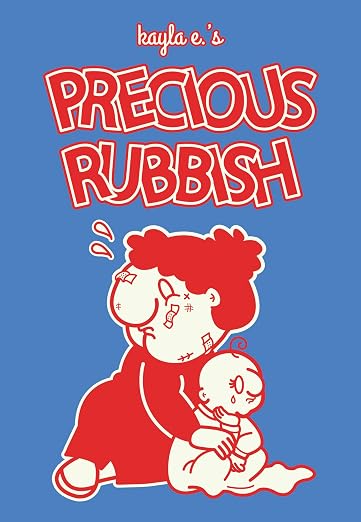
A nervous laugh and a wide-eyed reread. That’s the initial response most readers can expect from any given page of writer-artist Kayla E.’s Precious Rubbish. The award-winning graphic novel is a stylish comedy and memoir that is bright in color while being the exact opposite in tone. Centered on trauma, the comic is reminiscent of a friend sharing their troubled past through a stand-up routine. A tear or two may be shed before the laughter subsides in full. An aesthetic of classic cartoons and newspaper comic strips combines with sharp, modern humor and an unabashed vulnerability to make Precious Rubbish a necessary and unique read.
While there are lots of stories inside of Precious Rubbish, they all exist within a framework of childhood abuse and its ramifications. Each vignette is a sort of joke in itself, with the punchline almost always being the ill treatment of little Kayla. After a while, readers will feel the comedic repetition start to become predictable, and then it stops being so fun, but of course that’s when the book hits the hardest. This comic has nothing to offer its audience but silver linings, and they come almost exclusively in the form of humor so smart and quick it could have only been formed in some capacity as a mechanism of defense.
Interspersed between the plot-focused panels are all sorts of adverts, illustrations, and even interactive games, each presented with the same slanted irony that is the book’s staple. The scrapbook, stitched-together feel of Precious Rubbish is probably the most divisive decision in terms of structure. There is not a thorough throughline that readers can firmly follow from start to finish. Instead, the comic reads as a dark reflection, where memories show themselves in waves and reveal their connections to each other on their own devastating timetable. A firm rising action that builds to a satisfying climax and descends into a predictable resolution is not something anyone should expect, or want, from a piece of expression such as this, even if it does offer a thoughtful narrative along the way.

Some readers may see the highly stylized art as hard to connect with, but I found the blunt, crass presentation of such devastating scenes, in such an eye-catching aesthetic, eminently relatable and believable. The casual handwaving of stomach-turning depravity done to children by adults, who are meant to be protecting those very kids, is a stark reflection of reality. There is no escaping the dark truths that underpin every page of this bright book.
I would not say that the setting of Texas in particular is a loud player in Precious Rubbish, but the influence of the South is ever-present, and the facade of fun employed by the book is a prominent example of how it can be seen throughout. Readers familiar with the region will feel the creep of the familiar isolation of rural America and the false security of religious institutions as growing pressures on the book, both subtle and otherwise.
The book's art has a distinct style that could prove controversial with some audiences. To be completely uncharitable, there is a certain similarity between the main character’s aesthetics in Previous Rubbish and that of the Little Caesars Pizza mascot. From a more honest perspective, I found the rigid face structures repetitive and a bit hard to relate to. While the art never failed to express intentional emotions and portray coherent stories, the paper doll aesthetic sometimes separated the characters from reality too much for me.

During the sections with other face design choices, such as the witch and nun, I felt nuance and subtlety come through, which is lacking in the main cast. In defense of some of the choices I just critiqued, keeping the world and people around Kayla flat, simple, and consistent helps establish the perspective of looking back at one’s childhood and mentally recreating the scenes. The details of a man’s face or expression don't always matter when his actions telegraph everything anyone needs to know.
Precious Rubbish is a witty and addicting read, but every chuckle comes with an emotional gut punch as a follow-up. The technical skill in the writing and art is stunning and consistent, yet the relentless commitment to giving readers glimpses beyond the pristine facade into the harrowing, intimate truth of abuse and neglect puts the book in a league of its own. Harsh self-deprecating truths presented as gags and one-liners; the heart of Precious Rubbish is a vulnerable, revealing irony that is rare to see done well in any art, let alone comics.
I’m always looking for graphic novels that are changing the game, comics that are elevating themselves above the standard expectations. Despite the medium's long and storied legacy, only the most marketable have truly broken through into mainstream consciousness. Kayla E.’s Precious Rubbish is an example of how comic books can be relevant literature in the modern age. I find myself comparing the spirit of the work to Zoe Thorogood’s It's Lonely At The Centre Of The Earth, another heartfelt indie darling, from which I also hope the industry learns the right lessons. Readers searching for something unique and powerful can set their sights safely on Precious Rubbish.
Citation Station
Precious Rubbish. 2018. Kayla E. Fantagraphics.