The Dark Knight Returns for the First Time
The Great DC Sightsee

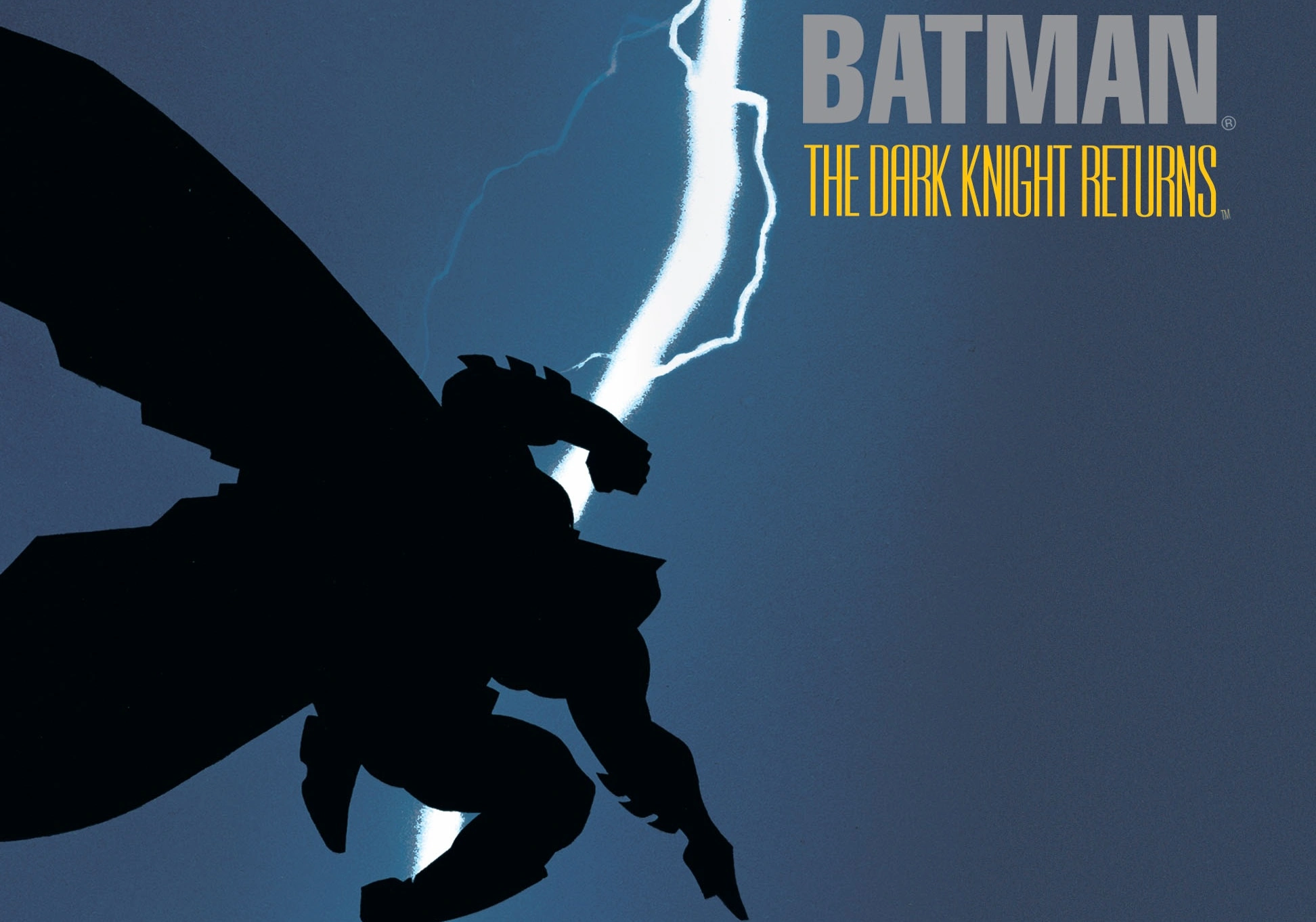
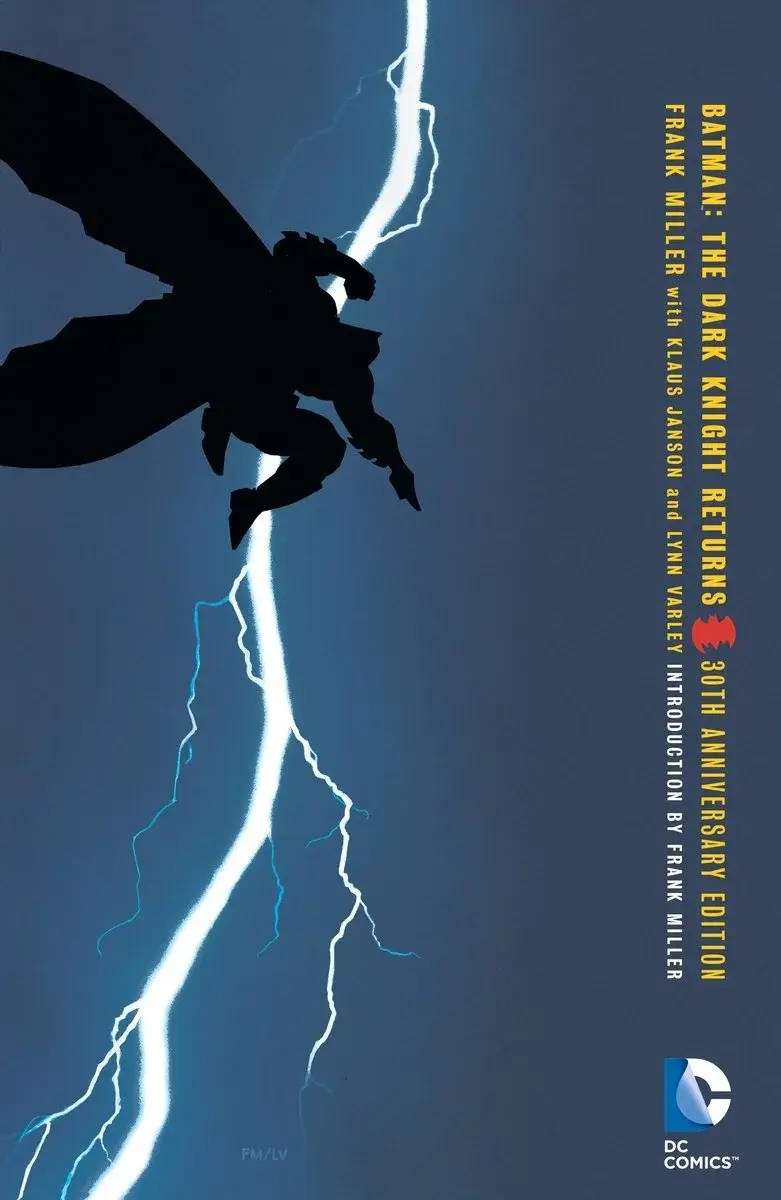
I have mentioned before that I have never been the biggest Batman fan, in terms of comics. My entry into the medium was through Marvel, and from there, I have mostly looked for more independent and substantive voices rather than works from the big publishers. Nowadays, I am getting into Post-Crisis DC comics, and that, of course, comes with stories of the World’s Greatest Detective and Most Popular Superhero. So far, I have found Batman’s backlog to be much more accessible than at least that of his Trinity counterparts. Where Wonder Woman and Superman come with suggestions of lengthy runs and tiring reading orders, Batman has a lot more discrete stories that have been collected and sold in understandable, intuitive packages. Of course, this is helped by the Caped Crusader’s higher-than-average batting average, in terms of quality from DC and Marvel. Previously, we covered Frank Miller’s much-loved Year One, so it seemed appropriate to take the time and review the equally lauded 1986 sequel, The Dark Knight Returns.
Alongside the likes of Alan Moore and Brian Bolland’s The Killing Joke, Frank Miller’s The Dark Knight Returns is often touted as the best of the best in terms of Batman stories, if not superhero stories in general. The tale of fifty-five-year-old Bruce Wayne returning to the streets of Gotham after a decade-long hiatus, the imagery and plot points of this arc have permeated throughout Batman media across movies, television, and everything else. The ubiquity of the story meant I was not going in completely blind and had certainly set the bar high, but, really, it turned out my preconceived notions were not all that accurate and were not any sort of hindrance to appreciating the book.
For a title that is cemented as an alternative universe, there is an undeniable sense that The Dark Knight Returns status quo is a true endgame scenario for the character of Batman in general. The tone and personality of Bruce Wayne presented in these pages align almost perfectly with the amalgamation and overall understanding of the hero across pop culture, to the point that there is an intuitive weight to this being the template for the end of Batman. As I read this book, I could not help but buy into this story serving as the true bow on the grand epic of Batman, for better or worse.
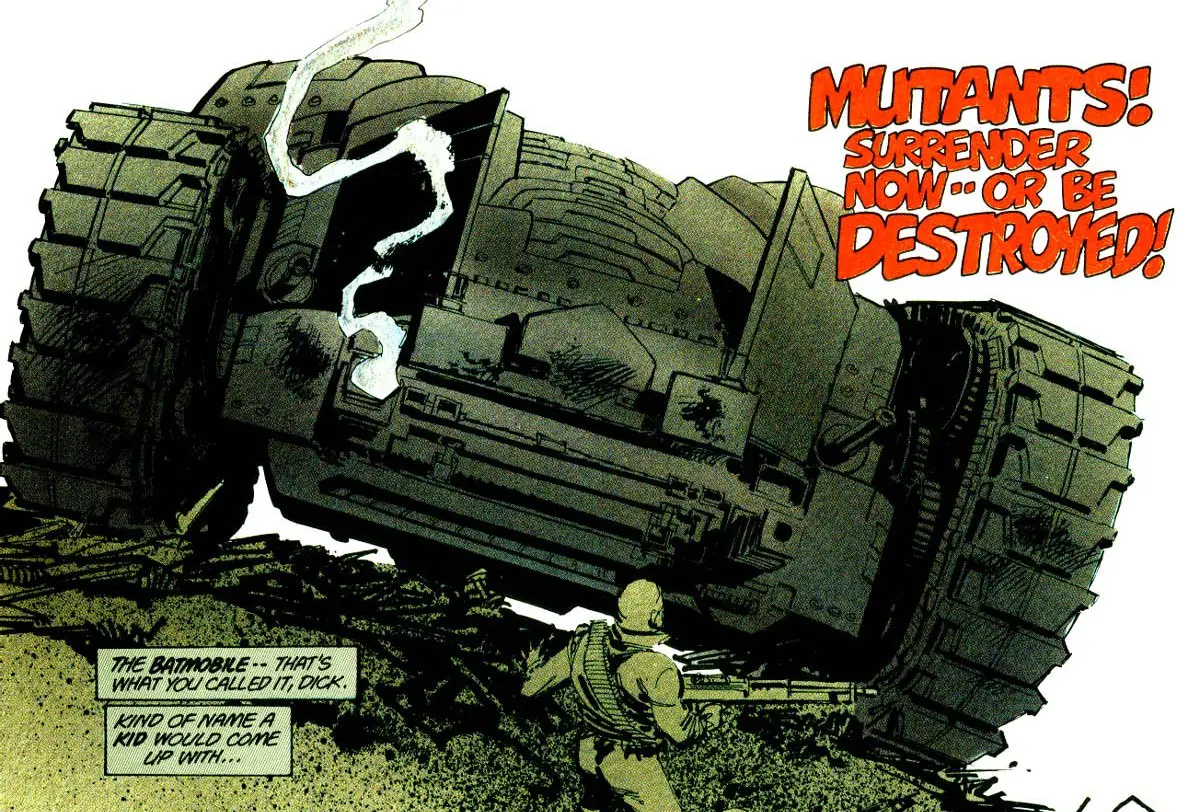
From the outset of the arc, there is a clear central contradiction in the hero’s return to crimefighting; Batman can’t do it anymore. Older and slower, Gotham’s defender is forced to break out all the tricks and toys he can muster to complete the typical tasks of a vigilante superhero. A tank and rubber bullets are emblematic of the limitations that the older Bruce faces, as well as his deteriorating mental state. Batman’s new physical reality is a trait that both defines the book and lies at the heart of its central themes around the fallibility of man and the systems in which we are entrenched.
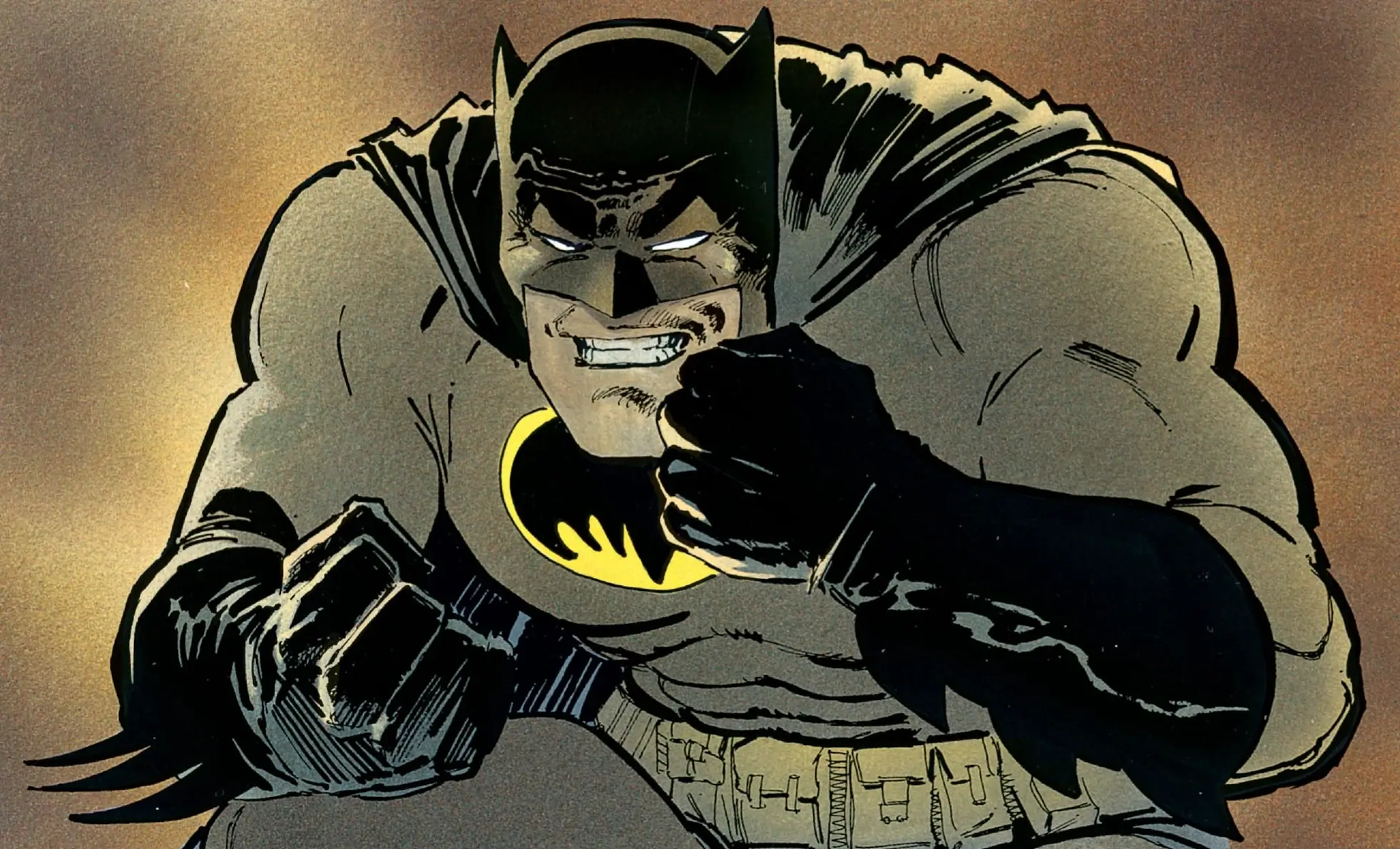
Over the course of the book, Batman faces a series of increasingly high-stakes and familiar opponents. The first two are basic crime and public perception. The hot new gang around Gotham is known as the Mutants, a nihilistic and violent bunch. While The Dark Knight Returns takes time to sell the new group’s depravity and danger, they are never anything more than outcast youths who have been failed and abandoned by society. The Mutants are impressionable followers, and they are painted as the inevitable output of the political framework of Gotham, or at least its failures. If a system produces a class of people who are not serviced by its structures, who lie outside the protections and prosperity that are allowed to others, those at the bottom will have no reason to abide by the system’s rules at all. Despite their eccentricities, TDKR places the Mutants in the same camp as, say, the man who shot Bruce Wayne’s parents, basic lawbreakers who are comparable to the types of people that exist everywhere in the real world. In the universe of comic books, these criminals, either career or one-off, each roll the dice in their illicit activities of hurting the wrong person, traumatizing the wrong kid, and creating a superhero, a Batman.
The topic of vigilante justice is explored in detail through talking-head newscast segments, which are a constant in the book (these TV-based panels are also the reader’s main insight into the brewing international conflict between the US and the Soviet Union). I was a bit surprised to see the comic quickly label Batman as a criminal-hunting criminal, as superhero comics tend not to be interested in or equipped to deal with such an assertion. Despite Batman’s popularity among some Gotham citizens, there is a clear understanding that it is supervillains, not common lawbreakers, who justify the existence of the violent vigilante, himself a lawbreaker. The Joker, Batman’s next major obstacle in this comic, is used to highlight this phenomenon and underscore the faulty logic which lies at the heart of the entire superhero concept.
In the context of The Dark Knight Returns, Joker has been effectively out of action for as long as Batman has been retired. The dichotomy established in these pages is that Joker engages in his chaos as a direct response to Batman's actions. Pulling back, the book proposes Joker, an agent of pain and misery who has no regard for any social contract or care for others, as the inescapable result of Batman’s existence. If the system cannot stop, and in fact occasionally encourages and relies upon people like Batman, those with the power to operate outside of the law, then a new category of person comes about, one into which the Joker belongs. In this context, Joker is the nihilistic outcome of a society that fails to provide necessary services, punishes the desperate for attempting to provide for themselves outside legal boundaries, while also permitting those with wealth and privilege to operate outside the law for what can be perceived as their own personal gratification.
To justify the existence of the Joker, someone truly depraved but infinitely capable, it is important to view Batman from the villain’s perspective. The Dark Knight may claim to fight for Gotham, but he does that in private, and his war consistently manifests as him beating up people on the street, with the help of various tools of military-grade technology. Batman is never fighting for a meal, for a place to sleep, for anything that is personally necessary. From the general public’s perspective, Batman, at his core, is a violent man with weapons who descends upon their city and attacks people in the streets. Bruce understands this to a degree, and in many Batman comics, you see the hero trying to build trust with the city by leaving a trail of justified violence and by apprehending the larger threats that rise to meet his existence. However, Bruce is just a man; he makes mistakes, and even if he doesn't, he can’t show everyone the truth at all times. His fallibility and limits mean there will always be a section of people who break laws and social contracts, either due to their own choices or forced by circumstance, who will be radicalized by Batman’s allowed existence. If people credibly fear that they will be attacked by a legally sanctioned madman for stealing a candy bar, the logic that creates a Joker becomes more understandable from the outside looking in. Of course, readers know Batman would typically not start swinging at a petty criminal, but there is just no way for the public at large to gauge or believe in such restraint. The general man has no idea what moral compass their city’s favorite vigilante follows, and from there, the Gotham resident’s path to nihilism becomes unfortunately more clear.
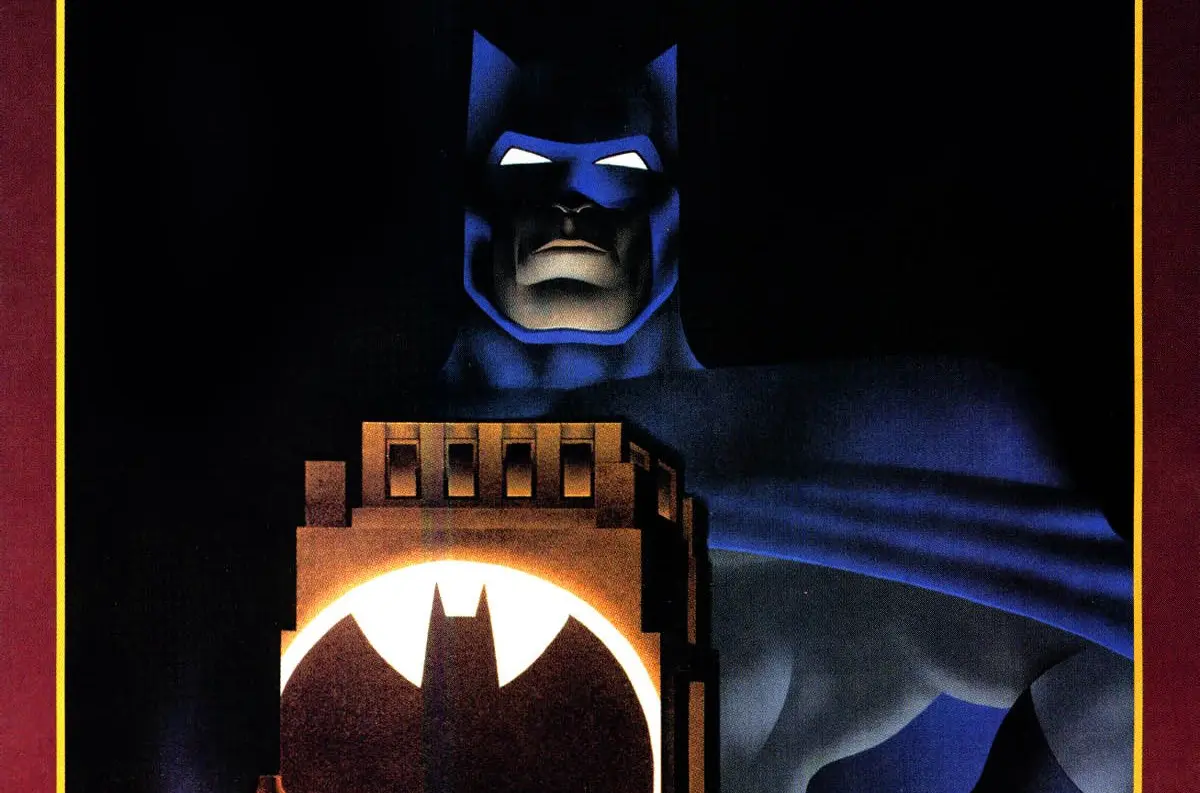
The question explored by Batman’s battle with the Joker in this book can be described as one posed over what exactly distinguishes the Dark Knight from his villains, or any other criminal. Bruce Wayne’s answer is his restraint and decision to refrain from taking the lives of those he brings down. On its surface, the assertion that simply not committing murder makes Batman morally tenable is a hard argument to make, but the Joker makes it nearly impossible. The point of killing is most interesting in its priority to Batman himself, rather than debating the actual veracity of the opinion. What’s important is that Batman feels he has an imperative not to cross the specific line, and the closer he comes to doing just that, the more inevitable his final retirement seems.
Batmans and Jokers, whether polar opposites or two sides of the same coin, are defined by their refusal of laws and norms, the systems that guide society. After the battle with Joker, The Dark Knight Returns widens its scope and examines the structures that underpin the modern status quo through this universe’s greatest enforcer, Superman. Readers are given a brief history lesson about the world of TDKR, where they learn that Superman, Batman, and all their superpowered friends were reined in by the United States government at some point in the past. Stricter laws and plunging public sentiment sent most heroes out of action, reducing Superman to an attack dog for the American government and leaving him to operate in near-complete secrecy. The Man of Steel’s complete commitment to promoting American political power may be a deviation from the hero’s typical characterization, but it allows for an intuitive framework for the final showdown between Batman and Superman.
By putting his efforts into expanding and protecting America’s global interests, Superman becomes the most powerful deterrent and, equally, the greatest escalatory factor on the international stage. With the Man of Steel up their sleeves, there is nothing stopping America’s unfettered economic and military domination, and readers see the end result of such unchecked power by the end of the comic. Superman’s decision to officially enmesh within the American legal system also solidifies his place as a true foil to Batman, and exposes one of The Caped Crusader’s most denied realities as being true.
The difference between Joker and Batman is not nearly as wide or profound as Bruce Wayne would like to believe. Gotham’s hero and villain both subvert societal regulations to further their own goals, and from a thousand-foot view, it is easy to see the Superman of these pages as the truly opposite category from Batman. It is then no surprise that when Batman is viewed as going too far in his fight with the Joker, and the US is simultaneously overextending itself in other countries and inviting increasing levels of blowback, Superman is tapped to step in and turn the might of the American military inwards.
A climactic mirror of his fight with Joker, Batman’s showdown with Superman is a pure distillation of the messy, gray morality that defines being a superhero. Where Batman saw a pitiful, out-of-control lunatic in the Joker, Superman represents those who see Batman as one and the same. Additionally, the book presents Batman as an equivalent to a super-nuclear warhead launched against America. The US is shown instituting a flawed system backed by near-ultimate force. The residents within the borders are failing, as we see Gotham devolve into poverty, gangs, and the whims of whoever can throw the hardest punch. Internationally, America is shown as casually stomping on the autonomy and wishes of other nations, thanks to the backing of its terrifying super weapon. As those at the top stayed free of consequence behind their red-caped shield, the amount of pain inflicted by their decisions only grew exponentially, inside and outside of the country for which they are responsible.
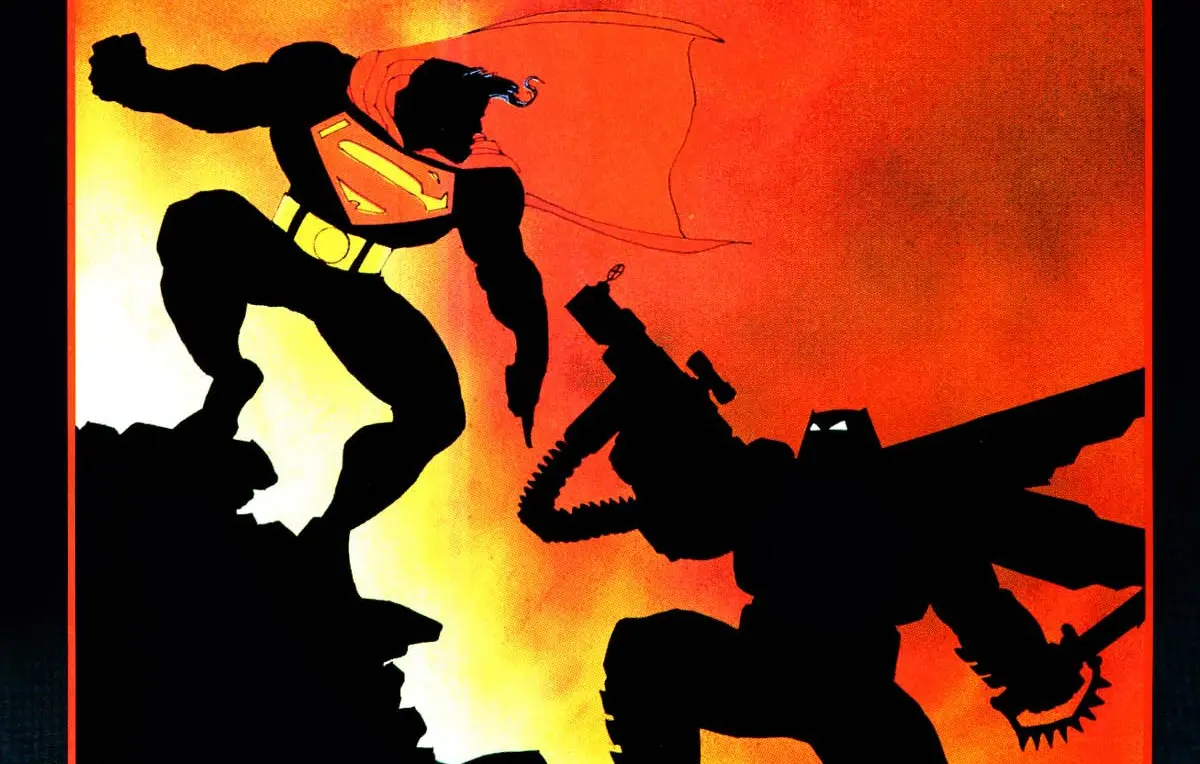
Much like the sequence in The Dark Knight Returns where readers see a man clutch a gun as he believes the world is ending, America is arming itself to rule over a wasteland. Of course, as we see, this means the man must wield the gun, brandish it so that nobody forgets who has it, and put down anyone who is crazy enough to try to take it from him. With the force of those failed by society, Batman strikes against Superman, who retaliates with the weight of a system built on the backs of those same people. The outcome is hardly in question, but from Batman’s view, you have to go out swinging, make it hurt enough that they change things so they don’t make another one of you, so they don’t get hit again.
There’s so much more to The Dark Knight Returns than a broad analysis of the story. The art, from fight scenes to facial expressions, is subtle and detailed, and fits with the tone so perfectly that readers will find Gotham erupting around them. Rough, erratic lines come together with striking colors to create the aesthetic of comic art that has been aged and battered yet hardened over time. Page layouts are interesting and intentional, with a consistent and effective use of multiple small panels in sequence to build tension, followed by large breakout and splash pages to deliver a payoff to the audience. Some of the pages are breathtaking, some are silly, some are just really, really cool, and they all come together to create an art direction that is distinct to the medium, despite being the template for many future adaptations. TDKR, along with Year One, exemplifies the darker Batman vibe that would prove to be popular across movies, comics, television, and everything else.
Tidbits of history about the alternative world of the book are sprinkled throughout the narrative, and are used sparingly enough to work well at capturing the reader’s attention and imagination while still making the world feel deep and lived-in. All of the pieces of lore seem crafted to specifically influence the events of this particular book, so it is odd to know that sequels to this series try to build out this specific alternate universe timeline further. While it is quite captivating, the The Dark Knight Returns universe does not seem like a world built to incorporate many other stories. However, my opinion on potential continued adventures in this version of Gotham may be influenced by my knowledge of how the real follow-up comics have been received.
A significant part of The Dark Knight Returns is the introduction of Carrie Kelley as Robin and her relationship with Batman as he re-establishes himself. The whole concept of a sidekick and ward is essential to the Batman mythos, and Carrie is as charming and capable as any of the Robins before her. As someone with not too many Batman comics under my belt, I did not latch onto this aspect of the book as hard as others, but I found Robin to be a breath of fresh air and a necessary humanizing element for the stoic, larger-than-life hero.
Moving forward with my reading of DC comics, Batman has certainly solidified as the hero I expect the most from. While I have been impressed with Superman and Wonder Woman, The Dark Knight Returns and Year One really stand apart from the rest in terms of quality and depth. As someone who has always gravitated towards the wacky side of Batman, it is promising to be pulled into a darker take on the hero without the book devolving into overly self-serious dramatics. TDKR manages to tell a top-tier Batman story, deconstruct the superhero genre, and critique the state of world politics and warfare with just four superb issues.
Citation Station
The Dark Knight Returns. 1986. DC Comics. Frank Miller (writer, artist), Klaus Janson (inker), John Costanza (letterer), Lynn Varley (colorist), Dick Giordano (editor), Dennis O'Neil (editor).